How Long Does It Take To Drive From Seattle To Olympic National Park?
The honest drive time from Seattle to Olympic National Park, ferry crossings, route choices, fees, and how guided day tours compare on time.
The honest answer to this question starts with a map problem. Olympic National Park sits on a peninsula, and Seattle sits on the other side of a body of water called Puget Sound. There is no bridge. Every route from Seattle to the park begins with a ferry crossing or a long drive around the southern tip of the Sound through Tacoma, and the park itself is enormous, nearly a million acres, so the finish line depends on whether you are aiming for Port Angeles, Hurricane Ridge, Lake Crescent, the Hoh Rain Forest, or the coast. The most common route, the Seattle to Bainbridge Island ferry followed by the drive up Highway 101 to Port Angeles, takes about 2.5 to 3 hours door to door. From Port Angeles, park destinations add more time, and a full loop of the peninsula's highlights is a full day of driving on its own.
How Long Does It Take To Drive From Seattle To Olympic National Park?
Plan on about 2.5 to 3 hours to reach Port Angeles from Seattle using the Bainbridge Island ferry, which includes a crossing of roughly 35 minutes and an 82-mile drive segment after the boat. From Port Angeles, Hurricane Ridge Road climbs another 17 miles south into the park. That makes the ridge, the most visited destination in the park, roughly a 3-hour trip from Seattle, often a little more, before you have parked a single car.
Those numbers deserve some unpacking, because they are best-case figures for a smooth sailing and light traffic. The ferry is first-come, first-served on the Seattle to Bainbridge route, with no vehicle reservations, which means a full boat on a summer Saturday morning can add a full sailing's wait, often close to an hour, to the front of your day. The drive from Bainbridge to Port Angeles runs through Poulsbo and along the shore of the Hood Canal on Highway 101, and it is a scenic, winding road where passing is limited, so a slow RV ahead of you can stretch the segment.
The other wrinkle is that Port Angeles is the gateway, not the park's interior. Lake Crescent sits about 18 miles west of Port Angeles. The Hoh Rain Forest is about a two-hour drive from Port Angeles via Upper Hoh Road. Kalaloch and Ruby Beach sit on the southwest coast, off Highway 101 south of the Hoh. A visitor who wants to see Hurricane Ridge and the Hoh Rain Forest in one day from Seattle is looking at a very long day on the road, which is exactly why the guided day tours from Seattle run 10 to 13 hours end to end.
For anyone weighing that tradeoff, the comparison of Olympic National Park Seattle day tours against a self-drive day is worth a separate look, and this site covers it in detail. The short version: the tour handles the ferry timing, the driving, and the parking lottery at the Hoh, which is a real factor in summer.
If you are sizing up the guided option instead of the steering wheel, these are the three ferry-based day tours from Seattle most readers compare first.
How Long Is The Ferry Ride From Seattle To Olympic National Park?
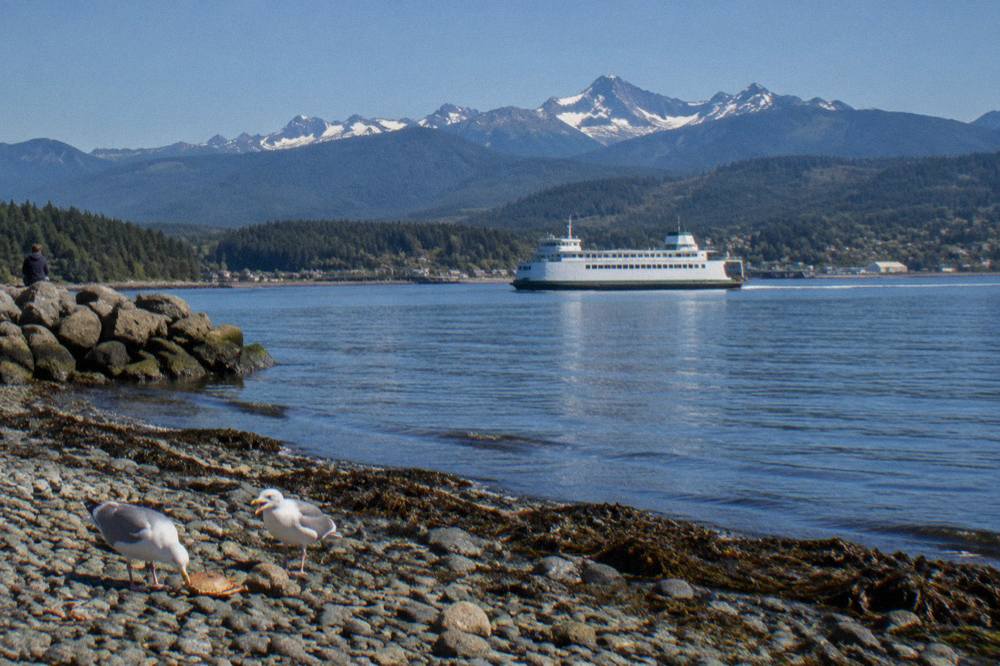
The Seattle to Bainbridge Island ferry crossing takes approximately 35 minutes, and the Edmonds to Kingston crossing takes approximately 30 minutes. Both routes are operated by Washington State Ferries, both are first-come, first-served with no vehicle reservations, and both feed into the Highway 101 corridor toward Port Angeles and the park.
The Seattle to Bainbridge route is the classic choice for park-bound travelers because it departs from the downtown Seattle waterfront and puts you on the most direct line to the Hood Canal and Highway 101. The Edmonds to Kingston route departs north of downtown and works well if you are starting from north Seattle or the Eastside, since it saves backtracking through the city. Both land you on the Kitsap Peninsula, and from either terminal the route to Port Angeles converges on Highway 101.
Two practical notes shape the timing. First, vehicle fares are collected in both directions, so the boat is paid for on the way back too, and walk-on passengers pay only when leaving Seattle. Second, the sailing schedule matters more than the crossing itself: boats sail frequently on these routes, but missing one at a busy time, especially with a vehicle queue, is the single most common way a 3-hour trip becomes a half-day slog. Washington State Ferries publishes the current sailing schedules and fares on its own site, and checking the day's schedule before you leave is the cheapest time-saver on the whole route.
There is also a second ferry that matters to some park itineraries, though it does not come from Seattle. The Black Ball Coho runs between Victoria, British Columbia and Port Angeles, with a crossing of roughly 90 minutes. That is the boat an international traveler would use, not a Seattle driver, but it explains why Port Angeles' waterfront has a second ferry terminal a short walk from the harbor.
Which Driving Route From Seattle Is Fastest?
For most travelers, the fastest route is the Seattle to Bainbridge Island ferry followed by Highway 101 up the Hood Canal to Port Angeles, about 2.5 to 3 hours total. Drivers starting north of Seattle often do better via the Edmonds to Kingston ferry, with a crossing of about 30 minutes. The drive around the south end of the Sound through Tacoma avoids ferries entirely but takes longer.
The southern land route runs from Seattle south through Tacoma, across the Narrows Bridge, and up the west side of the Sound to join Highway 101 toward Shelton and, eventually, the coast. It trades ferry uncertainty for a long stretch of interstate and two-lane highway. For a driver who misses a ferry by two minutes, it can feel like the smarter bet, but in normal conditions the ferry routes win on both time and scenery. The Bainbridge crossing alone, with the Seattle skyline behind you and the Olympics ahead, is one of the better 35 minutes of scenery in the state.
The route you pick also depends on your first park stop. Port Angeles, Hurricane Ridge, Lake Crescent, and Sol Duc are all best reached via Port Angeles. The Hoh Rain Forest and the coastal beaches can be reached either through Port Angeles or via the southwest route through Aberdeen and up Highway 101, and the southwest approach is the one that pairs naturally with Ruby Beach and Kalaloch. Check a maps app for the drive segments beyond the figures given here, because traffic and construction change them week to week.
| Route from Seattle | Ferry crossing | Best for | Notes |
|---|---|---|---|
| Seattle to Bainbridge ferry, then Highway 101 | About 35 minutes | Port Angeles, Hurricane Ridge, Lake Crescent | Departs downtown waterfront; no vehicle reservations |
| Edmonds to Kingston ferry, then Highway 104/101 | About 30 minutes | Travelers starting north or east of Seattle | Converges with the Bainbridge route near the Hood Canal |
| Southern land route via Tacoma | None | Ferry-averse drivers, southwest park areas | Longer in normal conditions; adds the Aberdeen approach to the coast |
Route choice is also where the guided products earn their keep. The Larger-Group Ferry Day Trip builds its 13-hour day around exactly this decision: the operator picks the ferry sailing, manages the queue, and runs the Highway 101 driving so guests ride instead of steer, and the listing includes the ferry rides, drinks, and the park fees in its covered items, with lunch left to you.
What Does The Drive Cost In Ferries And Park Entrance Fees?
Counting the boat and the gate, a Seattle driver pays a ferry fare in each direction plus the park entrance fee of $30 per private vehicle, valid for 7 consecutive days. Walk-on ferry passengers pay per person, and park entry on foot or bicycle is $15 per person for ages 16 and up, with children 15 and under free.
The ferry fare depends on how you ride. An adult walk-on pays for a round trip on the Seattle to Bainbridge route, while a vehicle and its driver pay one-way fares collected in both directions, with passengers in the vehicle paying separately. Washington State Ferries sets the exact amounts, and the numbers adjust periodically, so treat the operator's published fare table as the source of record when you plan the budget. A household of four with a car should expect the ferry leg to be a meaningful line item, not a rounding error.
The park entrance fee is separate and fixed. A private vehicle pays $30 for 7 consecutive days, a motorcycle pays $25, and a traveler entering on foot or by bicycle pays $15 per person. An Olympic Annual Pass costs $55 and covers a year from the month of purchase. The park does not accept cash at entrance stations, and the National Park Service publishes the full fee and pass schedule along with the year's fee-free days, when entry is free for United States citizens and residents. Pre-paying entry through Recreation.gov can shorten the wait at busy stations.
| Fee item | Amount | Validity |
|---|---|---|
| Private vehicle entrance | $30 | 7 consecutive days, covers all occupants |
| Motorcycle entrance | $25 | 7 days, up to 2 motorcycles and 4 passengers |
| Per person, on foot or bicycle | $15 | 7 days, ages 16 and up |
| Olympic Annual Pass | $55 | One year from month of purchase |
| Vehicle ferry fare | Set by Washington State Ferries | Collected in both directions |
One fee that is not yours to worry about: commercial tour vans and buses pay their own entrance fees, $75 for a van and $200 for a full coach, and those are operator costs built into a tour ticket, not something a guest pays at the gate.
Do Guided Day Tours From Seattle Really Run 10 To 13 Hours?
Yes, and the listings say so plainly. The ferry-based day tours from Seattle run from 10 to 13 hours depending on the product, because the day includes the ferry crossing, the drive to and through the park, stops at several destinations, and the return sailing. The Larger-Group Ferry Day Trip lists a 13-hour day from $239 per person, rated 4.9 across 400 reviews.
That number surprises people who imagine the park as a quick detour from the city. It should not. A 3-hour drive each way, plus stops, plus the ferry, plus parking and walking time at each destination, adds up to exactly those 10 to 13 hours. The tours are long because the geography is long, and any product promising Olympic National Park in half a day from Seattle is promising less park than it sounds like.
The roster illustrates the spread. The Small-Group Ferry Day Tour lists 11 hours from $188 per person, rated 4.6 across 943 reviews. The All-Inclusive Naturalist Day Tour lists 12 hours from $368 per person, rated 4.9 across 1067 reviews, with a professional naturalist guide and guided hikes or winter snowshoe treks. Rainforest And Beach Highlights lists 12 hours 30 minutes from $285 per person, rated 4.8 across 134 reviews. At the compact end, the SUV And Ferry Day Tour lists 10 hours from $485 per person, rated 3.8 across 22 reviews. Durations vary by traffic, ferry scheduling, and season, so the listing's own fine print is the authority on any given departure.
The case for handing the day to an operator is mostly about the driving itself. A reviewer named Daniel, writing about the Small-Group Hike Or Snowshoe Day, put it directly: "My not having to drive the entire way was a great benefit." That is the entire product proposition in one sentence, and for a day that runs 11 to 13 hours, it is not a small one.
Is It Cheaper To Drive Yourself Or Take A Tour?
For a solo traveler, a guided day tour from Seattle, starting at $188 per person, frequently beats the true cost of driving, once ferry fares both ways, the $30 vehicle entrance fee, and gas are counted. For a car of three or four people splitting costs, self-driving is usually cheaper per person, and the gap widens with every additional passenger.
The crossover point sits around two travelers, and it moves with the tour you pick. Against the $239 Larger-Group Ferry Day Trip or the $368 All-Inclusive Naturalist Day Tour, a full car of four wins the arithmetic easily. Against the $188 Small-Group Ferry Day Tour, which includes lunch, snacks, the park entrance fee, and the round-trip ferry crossing in its listed inclusions, a solo driver is almost certainly behind before the day starts. The SUV And Ferry Day Tour, from $485 per person, includes park entrance fees, the ferry fee, and private transportation, and reads as a premium small-vehicle option rather than a budget play.
Cost is only half the comparison, of course. The self-driver keeps total schedule freedom and pays for it with the ferry queue, the Hoh parking lottery, and a very long day behind the wheel on winding roads. The tour passenger reads, naps, or watches the Hood Canal go by. This site's guide to Olympic tours versus driving yourself works through the tradeoff in more detail, and the full cost breakdown of Olympic day tours runs the numbers tour by tour.
For readers who have done that arithmetic and landed on the guided side, the larger-group ferry product is the volume option.
What Road Closures Should You Know About Before You Drive?
Two closures matter. Highway 101 is closed at the Hoh River Bridge overnight, from 7 p.m. to 5:30 a.m. each night, October 13 to 19, with no detour across the river, though the Hoh Rain Forest stays reachable from Forks. Separately, Mora Road is closed to all traffic at the campground, so Rialto Beach is not accessible via Mora Road during repairs of severe winter flood damage.
The Hoh River Bridge closure splits the park's road network in a way that matters for route planning. North of the bridge sit Port Angeles, Hurricane Ridge, Lake Crescent, Sol Duc, Forks, Mora, and the Hoh Rain Forest. South of it sit Kalaloch, Queets, and Quinault. There is no crossing the river during the overnight closures, and the National Park Service notes that alternate routes around the east side of the Olympics add at least four hours. A driver planning a day that touches both the Hoh and Kalaloch needs to check the park's current road conditions page before committing to the plan, and the park's road and weather recording at 360-565-3131 carries the live status.
The Mora Road closure removes Rialto Beach from the practical map for now, and with it the Hole-in-the-Wall sea arch and the Rialto tide pools. Some tour listings, including the Hoh And Rialto products departing Port Angeles and Seattle, carry Rialto in their names, so anyone booking one should confirm the operator's current route on the listing before paying. Ruby Beach, Kalaloch, and Beach 4 sit directly on Highway 101 and are the reliable coastal stops while Mora Road is closed.
Beyond the closures, the seasonal pattern is predictable and published. Hurricane Ridge Road runs daily in summer and, in winter, is scheduled to open only Friday through Sunday and holiday Mondays, weather permitting, with all vehicles required to carry tire chains above the Heart O' the Hills entrance station from November 1 through April 1 and to be below the station by 5 p.m. on open days. Obstruction Point Road, the gravel spur off the ridge, typically opens from mid-June through October 15. The park is open 24 hours a day year-round, but from October through May some roads and facilities close or reduce hours, which is the honest answer to why winter itineraries look so different from summer ones.
When Should You Leave Seattle To Beat The Crowds?
Catch an early morning ferry, ideally a departure that lands you on the Kitsap Peninsula before 9 a.m., because the park's own guidance is that Hoh Rain Forest parking can reach capacity by 10 a.m. in summer, with the entrance station metering traffic and waits of 1 to 3 hours or more reported between 7:30 a.m. and 5 p.m.
That Hoh figure is the one that rearranges itineraries. It is not a soft suggestion about arriving early for a better spot; it is an operational reality in which cars are held at the entrance station and released as parking turns over. A driver leaving Seattle at 9 a.m. is structurally unable to beat it, because the ferry, the drive around the Hood Canal, and the Upper Hoh Road already consume the morning. Add the two-hour drive from Port Angeles to the Hoh and the arithmetic is unforgiving: to park at the Hoh before the lots fill, you are leaving Seattle at or before dawn.
Hurricane Ridge crowds on a smaller scale, since its parking is first-come, first-served with no reservation system, but the ridge road itself is the constraint in winter and the lots fill on summer weekends. Lake Crescent's Marymere Falls trailhead and the Sol Duc area see their own mid-morning waves. The general pattern holds everywhere: the reward for the first ferry of the day is not just an empty road, it is the only version of the day in which the park's most famous stops feel like yours.
Guided tours solve this by leaving early by design and by holding a place in the queue as a group. That is a quiet part of the value: a 13-hour tour day is front-loaded so the group is at the entrance before the metering starts, something a first-time visitor is unlikely to engineer alone.
Can You See The Park And Drive Back To Seattle In One Day?
Yes, but the day is long and the park coverage is narrow. A realistic one-day self-drive from Seattle covers Port Angeles plus one or two destinations, most often Hurricane Ridge and Lake Crescent, with the round trip running 10 to 12 hours including the ferries. Covering the Hoh Rain Forest or the coast as well pushes the day past 13 hours.
The one-day itinerary that works is the northern one. Ferry over in the early morning, drive to Port Angeles, take Hurricane Ridge Road up to the ridge, come back down, and continue west to Lake Crescent for a walk to Marymere Falls or a stop at the shore. Return via the same ferry corridor in the evening. That is a full, satisfying day, and it is roughly what several of the Seattle day tours actually deliver, with the listing durations to prove it.
The one-day itinerary that breaks is the everything loop. The Hoh Rain Forest is about a two-hour drive from Port Angeles, the coast is further, and the return to Seattle adds hours on top. Add the Hoh parking metering after 10 a.m. and the closure at the Hoh River Bridge, and the full loop is not a one-day object from Seattle in any season. The tours that attempt the most, like the Long Rainforest And Beach Day at 13 hours from $275 per person, rated 4.9 across a small pool of 86 reviews, are honest about the length precisely because there is no shorter version of that geography.
Travelers with two days should spend a night in Port Angeles or Forks and split the park in half. The site's guide to getting from Seattle to the park covers the lodging logic, and for a deeper dive, the one-day Olympic itinerary guide lays out the stops hour by hour.
For those who want the longest, most destination-dense guided version of the day, the small-group ferry product is the roster's most-reviewed ferry tour.
Is The Drive From Seattle Worth It Compared To Staying Overnight?
For a one-day visit, the drive is worth it only if you accept that most of your usable daylight hours go to road and ferry. Staying overnight in Port Angeles, Sequim, or Forks converts the same drive time into park time, and most repeat visitors land on the overnight plan after one exhausting day trip. The peninsula simply rewards slowing down.
The day-trip math is honest: about 2.5 to 3 hours each way to Port Angeles, plus deeper drives to the ridge, the lake, or the rain forest. That is the same total the tours advertise, which is why they run 10 to 13 hours. A day trip buys you a real taste of the park's northern half and nothing more. An overnight in Port Angeles puts Hurricane Ridge at 17 miles from your door, Lake Crescent at about 18 miles, and turns the Hoh into a reasonable morning drive instead of an expedition.
For travelers who cannot add a night, the guided day tour is the more humane version of the same day, and this is the audience the Olympic National Park Tours site exists for. A guest review from David_E on the Small-Group Ferry Day Tour captures the adaptive value a good operator adds: "When the ferry was not operational he drove us to Olympic instead." A self-driver with a closed ferry terminal is improvising at 7 a.m.; a tour operator is rerouting a van.
Whether you drive or ride, book the boat knowledge in advance: the schedule, the fare table, and the park's road status. Three sources cover it, the Washington State Ferries site, the park's road conditions page, and the 360-565-3131 recording. Everything else is timing.
For the full spread of ferry-based options from Seattle, all three of these handle the crossing, the driving, and the day's routing.
Common Questions About The Seattle To Olympic Drive
How Long Does It Take To Drive From Seattle To Olympic National Park?
About 2.5 to 3 hours to Port Angeles using the Seattle to Bainbridge ferry, which includes a roughly 35-minute crossing and an 82-mile drive after the boat. Hurricane Ridge Road climbs another 17 miles south of Port Angeles, and the Hoh Rain Forest is about a two-hour drive from Port Angeles.
How Long Is The Ferry Ride From Seattle To Olympic National Park?
The Seattle to Bainbridge Island crossing takes approximately 35 minutes, and the Edmonds to Kingston crossing approximately 30 minutes. Both are first-come, first-served with no vehicle reservations, so the wait for a full boat can add close to an hour in summer.
Do You Need A Reservation For The Ferry From Seattle?
No. The Seattle to Bainbridge and Edmonds to Kingston routes do not take vehicle reservations; vehicles line up and load in order. Arriving early for the first morning sailings is the practical way to guarantee a spot on busy summer weekends.
Is Driving Yourself Cheaper Than A Tour From Seattle?
For three or four people sharing a car, usually yes. For a solo traveler, often no: the Small-Group Ferry Day Tour starts at $188 per person and includes lunch, snacks, the park entrance fee, and the round-trip ferry, which a self-driver pays separately on top of gas.
Can You Visit Rialto Beach On A Day Trip From Seattle?
Not at present. Mora Road is closed to all traffic at the campground and Rialto Beach is not accessible via Mora Road during repairs of severe winter flood damage. Ruby Beach, Kalaloch, and Beach 4, all directly off Highway 101, are the coastal stops to plan around.
What Time Should You Leave Seattle To Beat The Crowds?
At or before dawn. The Hoh Rain Forest parking lots can reach capacity by 10 a.m. in summer, with entrance station metering producing waits of 1 to 3 hours or more, and the drive from Seattle to the Hoh consumes most of the morning on its own.